


Delhi High Court Holds Crocodile International Logo Infringes Lacoste’s Trademark and Copyright, Upholds Permanent Injunction
Delhi High Court Holds Crocodile International Logo Infringes Lacoste’s Trademark and Copyright, Upholds Permanent Injunction
Introduction
The Delhi High Court has held that the crocodile device used by Crocodile International infringes not only the trademark but also the copyright of the iconic crocodile logo of Lacoste.
A Division Bench comprising Justice C. Hari Shankar and Justice Om Prakash Shukla partly allowed cross appeals filed by both parties and modified the earlier ruling of the Single Judge dated August 14, 2024. While affirming trademark infringement, the Court held that the impugned device also infringed Lacoste’s copyright in its artistic crocodile emblem.
Factual Background
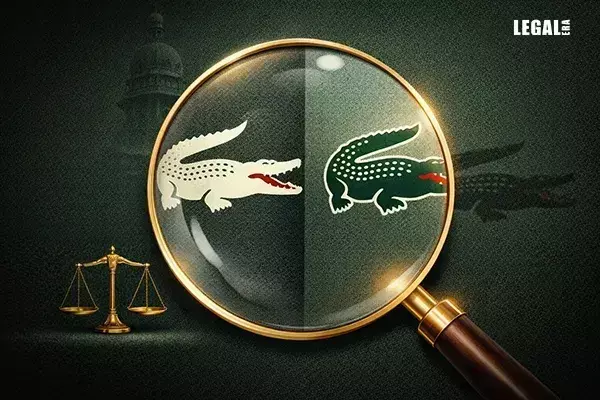
Lacoste is globally known for its distinctive crocodile logo used on clothing and fashion accessories. The company has held trademark registrations in India for its crocodile device since 1983 and claims substantial goodwill associated with the mark worldwide. The dispute arose from the use of a crocodile device by Crocodile International, depicting a crocodile facing left with a curved tail, scales, and an open jaw. Lacoste argued that the impugned device was deceptively similar to its own crocodile device mark, which depicts a crocodile facing right. According to Lacoste, the similarity in the posture, structure, and visual elements of the crocodile devices was likely to cause confusion among consumers.
Procedural Background
The dispute had earlier been decided by a Single Judge of the Delhi High Court on August 14, 2024. The Single Judge held that the impugned mark infringed Lacoste’s trademark rights but rejected the claim of copyright infringement. Both parties filed cross appeals before the Division Bench challenging aspects of the Single Judge’s decision. Lacoste sought recognition of copyright infringement, while Crocodile International contested the finding of trademark infringement.
Issues
1. Whether the crocodile device used by Crocodile International infringed Lacoste’s registered trademark in India.
2. Whether the impugned crocodile device also amounted to infringement of Lacoste’s copyright in its artistic logo.
3. Whether Crocodile International could rely on a coexistence agreement to justify the use of the mark in India.
Contentions of the Parties
Lacoste argued that it was the prior adopter and registered proprietor of the crocodile device mark and had built significant global and domestic goodwill associated with the logo.
It submitted that the impugned device used by Crocodile International was deceptively similar to its own mark and that the similarities in posture, body structure, scales, and overall visual presentation were likely to cause confusion among consumers.
Crocodile International contended that its founder, Dr. Tan Hian Tsing, had adopted the crocodile device in 1947 and that its use was protected under a coexistence agreement executed between the parties in 1983. It also relied on a 1985 communication, which it claimed extended the scope of the coexistence arrangement. The company further argued that the depiction of a crocodile was a common motif and that its device was independently created.
Reasoning and Analysis
The Court observed that both marks depicted crocodiles in similar horizontal postures with curved tails, scales, and open jaws. It held that the difference in the direction in which the crocodiles faced was insignificant and likely to go unnoticed by an average consumer with imperfect recollection. The Court therefore concluded that the impugned mark was deceptively similar to Lacoste’s registered device mark and amounted to trademark infringement under Section 29 of the Trade Marks Act.
On the issue of copyright infringement, the Division Bench disagreed with the reasoning of the Single Judge, who had applied the doctrine of merger on the ground that there were limited ways to depict a fierce crocodile. The Court held that the specific posture and visual characteristics of Lacoste’s crocodile emblem were matters of creative choice rather than necessity. It further observed that Crocodile International itself had used other crocodile depictions in different contexts, demonstrating that alternative representations were available.
The Court also noted that Crocodile International had knowledge of Lacoste’s mark since at least 1980 when disputes between the parties first arose. In these circumstances, the Court rejected the claim of independent creation. With respect to the coexistence agreement, the Court held that the agreement applied only to certain specified territories—Taiwan, Singapore, Indonesia, Malaysia, and Brunei—and did not extend to India. Accordingly, Crocodile International could not rely on the agreement to justify use of the impugned mark in India.
However, the Court upheld the rejection of Lacoste’s claim of passing off, observing that Lacoste had not produced sufficient admissible evidence demonstrating goodwill in India at the time Crocodile International entered the Indian market in 1998.
Decision
The Delhi High Court partly allowed the cross appeals and modified the Single Judge’s judgment. The Court affirmed the decree of permanent injunction restraining Crocodile International from using the impugned crocodile device mark in India and held that the mark infringed both Lacoste’s trademark and its copyright. However, the Court set aside the award of legal costs granted to Lacoste, noting that the company had taken over a decade to examine its witnesses during trial.
In this case the plaintiff was represented by Advocates Saif Khan, Shobhit Agarwal, Prajjwal Kushwaha and Shayal Anand. Meanwhile the defendant was represented by Senior Advocate Chander M Lall with Advocates Nancy Roy and Prakriti Varshney.