


Delhi High Court Settles 25-Year-Old Mars V Cadbury ‘CELEBRATIONS’ Dispute
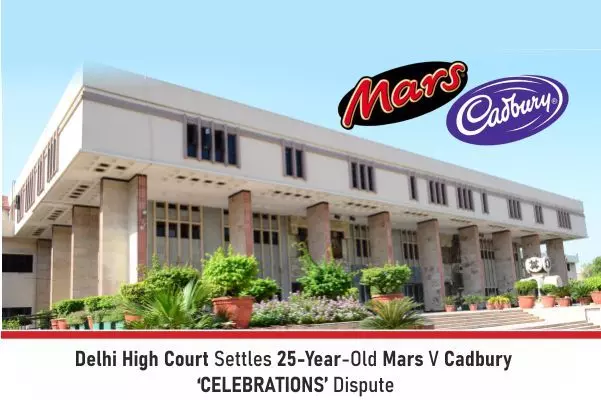
Delhi High Court Settles 25-Year-Old Mars v Cadbury ‘CELEBRATIONS’ Dispute
The leading law firm in India, Anand and Anand, represented Mars Incorporated (“Plaintiff”) in a long-standing trademark dispute with Cadbury (India) Ltd & Ors (“Defendants”) concerning the use of the mark “CELEBRATIONS”. The matter, pending for 25 years, was resolved through a mutual settlement between the parties, with the Delhi High Court passing a decree on October 10, 2025.
Background
Mars and Cadbury, two leading confectionery companies, had been engaged in litigation since 2000 regarding their respective rights over the trademark “CELEBRATIONS”. The dispute involved multiple opposition and rectification proceedings filed by both parties before the Indian Trade Marks Registry. Opposition proceedings challenge the registration of a trademark after its acceptance, while rectification proceedings seek cancellation or correction of an already registered mark.
Settlement Between the Parties
On July 2, 2025, Mars and Cadbury entered into a mutual settlement agreement. The key terms included:
- Withdrawal of the lawsuit CS(COMM) 409/2018 and all connected applications.
- Withdrawal of opposition proceedings filed by both parties against each other’s trademark applications for “CELEBRATIONS”.
- Withdrawal of rectification proceedings filed against registered marks relating to “CELEBRATIONS”.
- Undertaking to comply with the settlement within 10 days before the Trade Marks Registry.
- Agreement that the settlement constitutes full and final resolution of all disputes between the parties regarding the marks in question.
Court Proceedings and Decree
The parties jointly approached the Delhi High Court seeking a decree to record the settlement. The Court, led by Justice Sanjeev Narula, reviewed the terms and found them lawful and voluntarily executed. The Court recognized the historic nature of the dispute and acknowledged the proactive and constructive approach adopted by both companies to bring it to a close.
Public-Interest Gesture
In a unique and socially responsible move, Mars and Cadbury voluntarily undertook to distribute confectionery assortments worth ₹5 lakh each to schoolchildren in government and government-aided schools across Delhi during the festival of Diwali. The distribution, comprising chocolates, cookies, and other packaged products, is to be done in sealed retail packs under the supervision of the Directorate of Education, GNCTD, and the Delhi State Legal Services Authority (DSLSA). The gesture aims to symbolize goodwill, community spirit, and the joy of giving.
Conclusion
By mutual consent, the Delhi High Court decreed the suit in terms of the settlement, thereby bringing an end to nearly a quarter-century-long dispute. The Court highlighted that even protracted corporate disputes can be resolved amicably and that acts of social responsibility can complement legal closure. The decree reinforces that “CELEBRATIONS” now represents shared joy and goodwill, rather than rivalry.
The lead matter was argued by Pravin Anand (Managing Partner), Vaishali R. Mittal (Partner), Siddhant Chamola (Associate Partner), and Shivam Sharma (Advocate) for Mars (Plaintiff), and Nancy Roy(Advocate) for Cadbury (Defendants).
Click to know more about Anand and Anand
If you have a news or deal publication or would like to collaborate on content, columns, or article publications, connect with the Legal Era News Network Team and email us at info@legalera.in or call us on +91 8879634922.


