Forgery Allegations No Bar To Arbitration In ‘Pind Balluchi’ Trademark Row: Delhi High Court
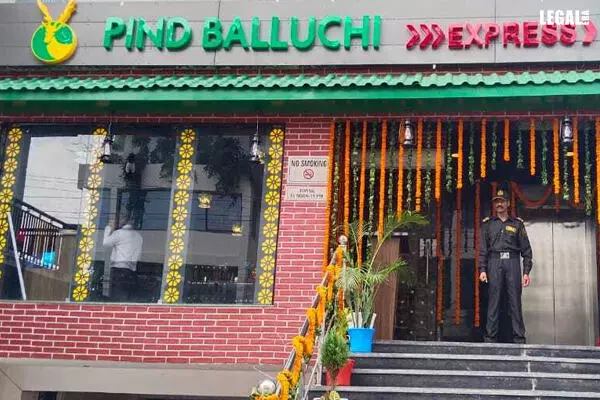
Forgery Allegations No Bar to Arbitration In ‘Pind Balluchi’ Trademark Row: Delhi High Court
Introduction
The Delhi High Court has upheld the referral of a trademark infringement and passing-off dispute involving the well-known restaurant brand “Pind Balluchi” to arbitration, setting aside a Commercial Court order that had refused arbitral reference on allegations of forgery. The Court held that disputes arising out of a pre-existing commercial relationship, even when allegations of forgery are raised, are generally arbitrable and must be examined by the arbitral tribunal.
The decision was delivered by a Division Bench comprising Justice C. Hari Shankar and Justice Om Prakash Shukla.
Factual Background
M/s Triom Hospitality, a partnership firm, operates a restaurant under the name “Pind Balluchi” at Dwarka, Delhi. M/s J.S. Hospitality Services Pvt. Ltd., the respondent, is the registered proprietor of the trademark “Pind Balluchi” in multiple classes and operates a nationwide chain of restaurants under the same brand.
According to J.S. Hospitality, it enjoys substantial goodwill and reputation in the restaurant industry. In July 2024, it was discovered that Triom was operating a restaurant under the “Pind Balluchi” name without authorisation.
Procedural Background
J.S. Hospitality instituted a commercial suit alleging trademark infringement and passing off. On August 16, 2024, the Commercial Court granted an ad-interim injunction restraining Triom from using the “Pind Balluchi” mark.
Triom thereafter filed an application to vacate the injunction, and an application under Section 8 of the Arbitration and Conciliation Act, 1996, seeking reference of the dispute to arbitration on the basis of a Memorandum of Understanding dated June 22, 2022, which allegedly contained an arbitration clause.
J.S. Hospitality denied execution of the MOU and alleged that it was forged. Accepting this contention, the Commercial Court dismissed Triom’s Section 8 application, holding that the dispute was non-arbitrable. Aggrieved, Triom preferred an appeal under Section 37 of the Arbitration Act before the Delhi High Court.
Issues
1. Whether allegations of forgery of an arbitration agreement justify refusal of reference under Section 8 of the Arbitration Act.
2. Whether the Commercial Court exceeded its jurisdiction by undertaking a detailed evidentiary examination at the referral stage.
3. Whether the trademark infringement and passing-off dispute arising from a commercial relationship was arbitrable.
Contentions of the Parties
Triom Hospitality argued that Section 8 casts a mandatory obligation on courts to refer parties to arbitration unless it is found that no arbitration agreement exists prima facie. It contended that mere allegations of forgery or fraud do not render a dispute non-arbitrable and must be examined by the arbitral tribunal.
J.S. Hospitality, on the other hand, submitted that courts are empowered to examine the prima facie existence and validity of an arbitration agreement. It argued that once forgery of the MOU was prima facie established, the dispute became non-arbitrable and reference ought to be refused.
Reasoning and Analysis
The High Court held that the scope of judicial examination at the Section 8 stage is extremely limited. Relying on precedents including Mayavati Trading Pvt. Ltd. v. Pradyuat Deb Burman, the Court reiterated that referral may be refused only in rare cases where the arbitration agreement is ex facie non-existent, invalid, or the dispute is manifestly non-arbitrable.
The Court found that the Commercial Court had undertaken an impermissible detailed evaluation of evidence, including examination of signatures and surrounding circumstances, which is contrary to the principles of kompetenz-kompetenz under Section 16 of the Arbitration Act.
It observed that allegations of forgery arising out of a commercial relationship are themselves arbitrable and require substantive evidence-based adjudication, which falls squarely within the domain of the arbitral tribunal.
The Bench noted that both parties admitted the existence of a prior commercial relationship. In such circumstances, determining the genuineness of the MOU could not be conclusively decided at the referral stage.
Decision
The Delhi High Court allowed the appeal, set aside the Commercial Court’s order refusing arbitral reference, and referred the parties to arbitration. It held that the arbitral tribunal is the appropriate forum to examine the validity and genuineness of the disputed MOU and to adjudicate the underlying trademark and passing-off claims.
In this case the appellant was represented by Dr. Amit George, Mr. Rajiv Kumar, Mr. Rupam Jha, Mr. Adhishwar Suri, Ms. Ibamsara Syiemlieh, Mr. Dushyant Kaul & Ms. Medhavi Bhatia, Advocates. Meanwhile the respondent was represented by Mr. J. Sai Deepak, Senior Advocate with Mr. Vikas Tomar, Advocate.