


Supreme Court Declines to Stay Adani’s JAL Resolution Plan, Orders Priority Hearing of Vedanta’s NCLAT Appeals
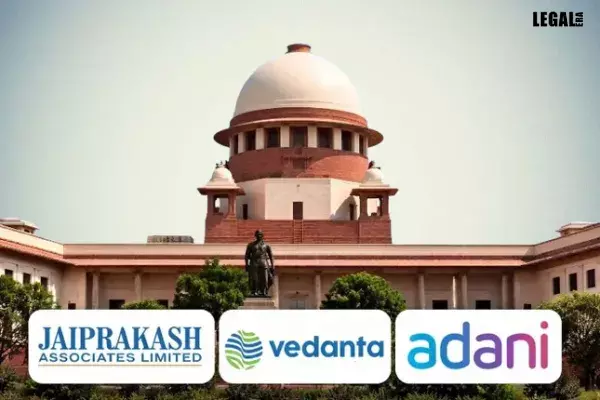
Supreme Court Declines to Stay Adani’s JAL Resolution Plan, Orders Priority Hearing of Vedanta’s NCLAT Appeals
Introduction
The Supreme Court has declined to interfere with the implementation of Adani Enterprises Ltd.’s resolution plan for Jaiprakash Associates Ltd. (JAL), while directing the NCLAT to hear Vedanta’s appeals on priority on 10 April 2026. The Court also protected the appellate process by directing that any major policy decision by the monitoring committee must first receive leave of the NCLAT.
Factual Background
The insolvency proceedings concern Jaiprakash Associates Ltd., which was admitted into CIRP in June 2024 following financial distress and a petition filed by ICICI Bank. During the resolution process, Vedanta Ltd. submitted a bid valued at approximately ₹17,000 crore, while Adani Enterprises Ltd. submitted a lower plan valued at approximately ₹15,000 crore (reported around ₹14,500–14,535 crore in court proceedings). Despite Vedanta’s higher overall value, the Committee of Creditors approved Adani’s plan with 93.81% voting share, citing stronger upfront payment terms and execution certainty.
Vedanta challenged the approval, arguing that its bid reflected higher gross value and better net present value, and that disregarding its revised addendum was contrary to the IBC’s value maximisation objective.
Procedural Background
The NCLT Allahabad Bench, by order dated 17 March 2026, approved Adani’s resolution plan. Vedanta appealed before the NCLAT, which on 24 March 2026 declined interim relief and allowed implementation of the approved plan to continue, while clarifying that all steps would remain subject to the final outcome of the appeals.
Aggrieved by refusal of interim protection, Vedanta approached the Supreme Court seeking a stay on implementation, particularly objecting to steps such as delisting and structural changes which, according to it, could create irreversible consequences.
Issues
1. Whether the Supreme Court should stay implementation of Adani’s approved resolution plan pending Vedanta’s NCLAT appeals.
2. Whether allowing implementation during appeal would cause irreversible prejudice to Vedanta and creditors.
3. Whether the monitoring committee’s powers should be restricted pending final appellate adjudication.
Contentions of Parties
Vedanta Ltd., through Senior Advocate Kapil Sibal, argued that the core challenge to the CoC’s decision had not yet been adjudicated by the NCLAT, and that allowing implementation, especially delisting of JAL and structural policy changes—could seriously prejudice creditors even if the appeal later succeeds. It was submitted that Vedanta’s proposal was financially superior and that creditors stood to receive a higher value under its plan.
The CoC, represented by Solicitor General Tushar Mehta, contended that implementation should continue because the NCLAT had already preserved the final rights of parties by making all actions subject to the result of the appeal. It was argued that structural changes, if necessary, could be reversed and that concerns of irreversibility were overstated.
Reasoning and Analysis
The Supreme Court declined to examine the merits of the competing bids at this stage, observing that the NCLAT had already fixed Vedanta’s appeals for final hearing on 10 April 2026. In light of the imminent appellate hearing, the Bench held that there was no reason to interfere with the impugned NCLAT order.
At the same time, recognising the far-reaching consequences of implementation of a large insolvency resolution involving JAL, the Court introduced an important safeguard: the monitoring committee cannot take any major policy decision without first seeking leave of the NCLAT. This ensures that irreversible or strategic steps are subject to appellate supervision while the challenge remains pending.
The Court further noted that Vedanta’s interests were already adequately protected by the NCLAT’s earlier order, which had preserved the outcome of the appeals, and therefore no separate interim direction was necessary. It accordingly requested the NCLAT to hear the appeals out of turn on the scheduled date or immediately on the next working day if arguments remain incomplete.
Decision
The Supreme Court refused to stay implementation of Adani Enterprises Ltd.’s resolution plan for Jaiprakash Associates Ltd., while directing the NCLAT to hear Vedanta’s appeals on priority on 10 April 2026. It further directed that any major policy decision by the monitoring committee shall require prior leave of the NCLAT.