


Trilegal Successfully Represents Green Infra And Sterling Agro In Landmark Supreme Court Ruling On Renewable Energy Tariff Framework
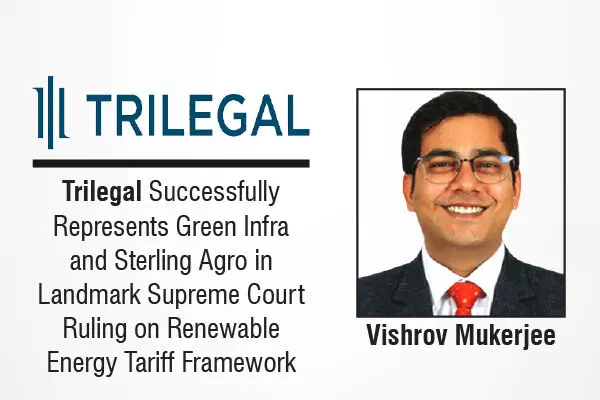
Trilegal Successfully Represents Green Infra and Sterling Agro in Landmark Supreme Court Ruling on Renewable Energy Tariff Framework
The leading law firm in India, Trilegal successfully represented Green Infra and Sterling Agro before the Supreme Court of India in a precedent-setting judgment that fundamentally strengthens India in a Civil Appeal filed by the Southern Power Distribution Company of Andhra Pradesh Limited (“AP Discoms”). The dispute arose when the AP Discoms sought to deduct the Generation Based Incentive (“GBI”) a financial benefit provided by the Ministry of New and Renewable Energy (“MNRE”) to incentivise wind power generation, from the tariff payable to the Wind Power Generators (“WPGs”).
Key Ruling
The Supreme Court has held that the Generation-Based Incentive (GBI) granted by the Ministry of New and Renewable Energy (MNRE) cannot be adjusted by State Electricity Regulatory Commissions (SERCs) while determining the tariff.
While the Andhra Pradesh Electricity Regulatory Commission (APERC) initially allowed this deduction, the Appellate Tribunal for Electricity (APTEL) reversed the decision, prompting the AP Discoms to file a Civil Appeal before the Supreme Court.
From Vishrov Mukherjee, Partner- Dispute Resolution practice, Trilegal said,
“ This landmark judgment, while emphasising that various stakeholders should act in conjunction, decisively affirms that renewable energy incentives must operate as intended and cannot be offset through tariff mechanisms. This clarity is critical for preserving project economics and will significantly enhance confidence in India’s renewable energy framework.”
Matter Significance
This judgment is a monumental victory for the entire renewable energy sector. By unequivocally ring-fencing central government incentives from being absorbed or set-off by distribution companies and state regulators, the Supreme Court has safeguarded existing project economics. Looking forward, this ruling provides critical regulatory certainty, ensuring that future financial incentives introduced by the Union Government to accelerate India's transition to renewable energy will reach their intended beneficiaries without state-level dilution.
Team
The Trilegal Dispute Resolution team advising on the matter was led by Vishrov Mukerjee (Partner) and comprised Pratyush Singh (Counsel), Damodar Solanki (Senior Associate), and Deepak Thakur (Associate).
Conclusion
This landmark ruling provides significant clarity in renewable energy tariff regulation and reinforces the financial viability of clean energy projects. It marks an important step in strengthening India’s clean energy transition by ensuring that policy incentives like GBI are preserved and not diluted during tariff determination.
Click to know more about Trilegal
If you have a news or deal publication or would like to collaborate on content, columns, or article publications, connect with the Legal Era News Network Team and email us at info@legalera.in or call us on +91 8879634922.


