


Vedanta Moves Supreme Court Against NCLAT’s Refusal To Stay Adani’s JAL Resolution Plan, Cites Higher Bid Ignored
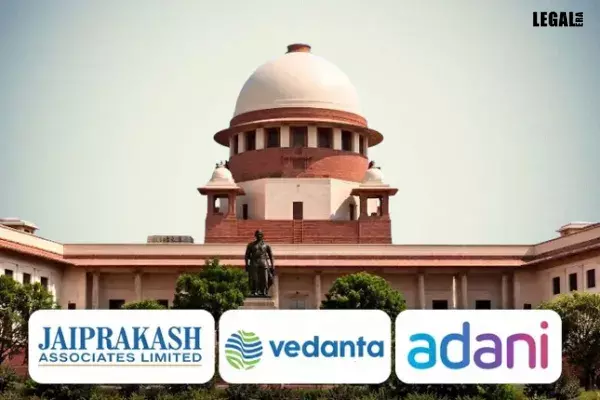
Vedanta Moves Supreme Court Against NCLAT’s Refusal To Stay Adani’s JAL Resolution Plan, Cites Higher Bid Ignored
Introduction
Vedanta Ltd has approached the Supreme Court of India challenging the refusal of the National Company Law Appellate Tribunal to grant interim relief against the implementation of Adani Enterprises Ltd’s resolution plan for Jaiprakash Associates Ltd. The challenge raises issues concerning value maximisation under the Insolvency and Bankruptcy Code, 2016, particularly where a higher overall bid was allegedly ignored in favour of a lower bid with stronger upfront payment terms.
Factual Background
Jaiprakash Associates Ltd, engaged in construction, cement, and hospitality, entered CIRP in June 2024 on a petition filed by ICICI Bank after prolonged financial distress. Despite prior sale of multiple cement assets to reduce debt, the company remained unable to service its obligations.
During the CIRP, Vedanta Ltd submitted the highest overall bid, reportedly valued at approximately ₹17,000 crore. However, the Committee of Creditors approved the competing resolution plan submitted by Adani Enterprises Ltd, valued at around ₹15,000 crore, citing more favourable upfront cash recovery and implementation certainty. The NCLT approved Adani’s plan on 17 March 2026 with a 93.81% CoC voting share.
Procedural Background
Aggrieved by the alleged non-consideration of its superior offer, Vedanta Ltd filed an appeal before the NCLAT. It specifically sought interim relief to restrain implementation of the approved resolution plan pending adjudication of its appeal. By order dated 24 March 2026, the NCLAT declined to stay implementation of the plan, while clarifying that the implementation would remain subject to the final outcome of the appeal. Vedanta has now carried the matter to the Supreme Court.
Issues
1. Whether refusal to stay implementation of Adani’s approved resolution plan defeats the value maximisation objective under the IBC.
2. Whether the CoC could lawfully prefer a lower-value bid on the basis of stronger upfront payment terms.
3. Whether Vedanta’s addendum and higher net asset value offer were wrongly disregarded.
Contentions of the Parties
Vedanta Ltd contends that its bid offered a significantly higher overall value of approximately ₹17,000 crore, including a net asset value of ₹12,505.85 crore, and therefore best served the IBC’s objective of value maximisation. It has argued that its addendum dated 8 November 2025 was improperly ignored by the CoC, leading to an arbitrary preference for a lower bid.
It is further contended that allowing implementation of the plan during pendency of appeal may render the challenge infructuous and create irreversible consequences, thereby necessitating interim protection.
On the other hand, the approved plan of Adani Enterprises Ltd was reportedly preferred by the CoC because of stronger upfront payment terms and perceived certainty in execution, which the lenders considered commercially superior despite the lower headline value.
Reasoning and Analysis
The present controversy centers on the recurring tension under the IBC between headline bid value and commercial certainty of recovery. While the CoC’s commercial wisdom is ordinarily insulated from judicial review, Vedanta’s challenge raises the narrower issue of whether a materially higher bid was excluded without due consideration, thereby undermining the principle of value maximisation.
The NCLAT’s refusal to grant interim relief indicates judicial reluctance to halt implementation once a resolution plan has received overwhelming creditor approval. At the same time, the observation that implementation remains subject to the outcome of appeal preserves the appellate challenge in form, though Vedanta’s move to the Supreme Court suggests concern that practical implementation may create fait accompli consequences.
Decision
The matter is now pending before the Supreme Court of India, where Vedanta Ltd seeks protection against further implementation of Adani Enterprises Ltd’s resolution plan for Jaiprakash Associates Ltd.