


Shivam Mehta, Executive Partner At Lakshmikumaran And Sridharan Attorneys, Highlights Pre-Budget Expectations For Indian Businesses
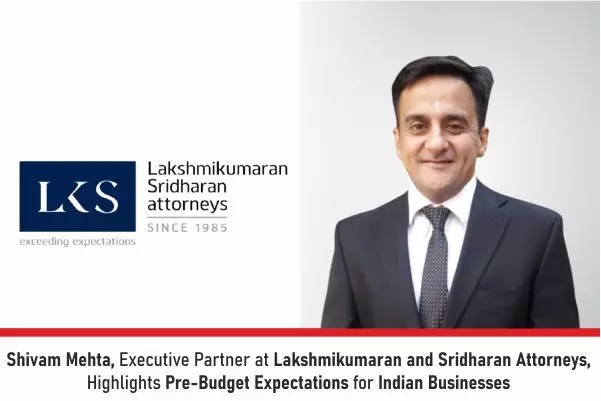
Shivam Mehta, Executive Partner at Lakshmikumaran and Sridharan Attorneys, Highlights Pre-Budget Expectations for Indian Businesses
The premier, full-service Indian law firm, Lakshmikumaran and Sridharan Attorneys, provide insights on key pre-budget expectations to address challenges faced by businesses under the current indirect tax framework. Shivam Mehta, Executive Partner at the firm, shares his perspective on issues such as GST compliance, mixed supply, state incentive schemes, and customs rationalisation that are likely to shape the upcoming Budget.
Mixed Supply
A key challenge that has emerged post GST 2.0 is the distinction between ‘composite supply’ and ‘mixed supply’ and their tax treatment, due to widening of the GST rate gap to 13%. While as a concept, mixed supply has emerged way back in matured legislation like Australia, Malaysia and the EU, approach adopted by India differs completely. In India, even a minor ancillary item in a bundled price can tip the entire bundle as a mixed supply and attract the highest tax rate. Other countries have safeguards to prevent such anomalies. Given the importance of promotional schemes to business, we expect appropriate clarifications or amendments in the upcoming Budget addressing minor promotional items bundled with main product.
State Schemes
Currently, state incentive schemes reimburse taxpayers based on the Net Cash GST paid, that is, the tax actually paid from the electronic cash ledger after exhausting the credit ledger balance. With recent GST rate reductions in GST 2.0, output tax liabilities have fallen significantly for many industries, leading to significant balances in the electronic credit ledger. As a result, state incentives are anticipated to be reduced or may be wiped out entirely. The Government should recognise these challenges and consider appropriate amendments to state schemes or provide for refunds of ITC on capital goods and input services to ensure that incentives remain effective.
Refund in case of closure of business
As of today, the GST law does not provide any provision for the refund of accumulated unutilised ITC upon closure of business, leaving significant credit trapped with taxpayers who often feel compelled to maintain registration in the hope of utilising it. The Division Bench of the Sikkim High Court has held that refund is not available in such cases because the statute does not recognise business closure as a ground for refund. While courts in the pre-GST era granted such refunds, the current legal position creates uncertainty and undermines ease of doing business. To support ease of doing business, appropriate amendments or clarifications in the GST law are required in the Budget to allow legitimate ITC refunds on closure.
Rationalization of Custom Duties
The Government, with a view to develop India as a manufacturing hub for the global market has introduced Phased Manufacturing Program to promote indigenous manufacturing and assemblies of various goods. To encourage the ‘Make in India’ campaign, the curtailment of import duties surrounding more products such as electronics, pharmaceuticals, healthcare products, medical equipment and home appliances may be seen in this budget. It is expected that budget may also focus on simplifying the customs duty structure to minimize rate multiplicity, and reduce classification disputes.
Amnesty Scheme: Clearing the backlog under Customs
A much-needed amnesty scheme under the Customs Law to resolve long-pending indirect tax disputes is expected. With litigation tying up crores and burdening businesses, a structured resolution mechanism would help companies, particularly small enterprises to clear past dues and move forward. This will not only ease pressure on courts and customs authorities, but will also enhance ease of doing business and investor confidence.
GST Council Recommendations
The industry expects that the key amendments recommended by the 56th GST Council, such as rationalising Section 15 and Section 34 for post-sale discount schemes and omitting the intermediary services place of supply rule will be implemented through legislative changes in the upcoming Budget.
Duty Inversion
While High Courts have granted refunds where ITC accumulated due to different GST rates on the same product at different times, the Government, through FAQs and circulars, has repeatedly denied such refunds. Additionally, with GST 2.0, many businesses are facing increased ITC accumulation, and those with the same rate on inputs and outputs are particularly burdened by credits on services and capital goods that remain unutilised. The industry is, therefore, looking for relief on refund of ITC on services and capital goods in the upcoming Budget.
Conclusion
Given the evolving GST and customs landscape, the upcoming Union Budget is expected to address critical business concerns, provide clarity on mixed supply and ITC refunds, rationalise custom duties, and ensure state incentive schemes remain effective. Such measures will not only support ease of doing business but also strengthen India’s position as a global manufacturing hub.
Click to know more about Lakshmikumaran and Sridharan Attorneys
If you have a news or deal publication or would like to collaborate on content, columns, or article publications, connect with the Legal Era News Network Team and email us at info@legalera.in or call us on +91 8879634922.


