


M&CO Legal Represents Applicant In DIFC Court Contempt Ruling; USD 75,000 Fine Imposed On Each Contemnor
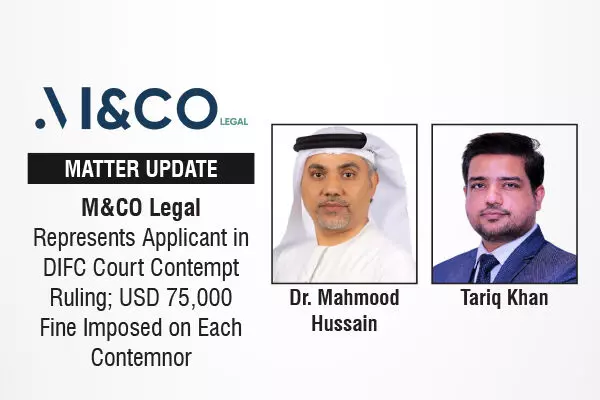
M&CO Legal Represents Applicant in DIFC Court Contempt Ruling; USD 75,000 Fine Imposed on Each Contemnor
M&CO Legal, the prominent boutique law firm headquartered in Dubai (DIFC) with a strong presence in the UAE and Saudi Arabia, successfully represented the Applicant in Oswin v Otila & Ondray (ARB-032/2025) before the DIFC Court of First Instance.
Introduction
In an important decision reinforcing the authority of the DIFC Courts, the Court held two individuals and a company in contempt of court for breaching an injunction and anti-suit injunction. The Court imposed USD 75,000 fines on each contemnor, ordered costs on an indemnity basis, and referred the matter to the Attorney General of Dubai for consideration of committal if contempt is not purged.
The judgment delivers a clear message: court orders must be complied with unless and until they are set aside on appeal.
Background of the Dispute
The dispute arose from a joint venture arrangement relating to the operation and management of a facility.
Earlier in the proceedings, the DIFC Court granted:
- An injunction restraining the defendants from acting on behalf of the joint venture company or interfering with the management of the facility without the required corporate approvals; and
- An anti-suit injunction requiring them to discontinue proceedings before the Abu Dhabi courts.
Despite these orders, the defendants continued litigation before the Abu Dhabi Court of First Instance, the Court of Appeal and the Court of Cassation, and later commenced fresh proceedings seeking to remove the claimant as operator of the plant.
The claimant subsequently applied for committal of the defendants for contempt of court.
Service Objection Rejected
At the hearing, the respondents sought an adjournment on the basis that Ozlem had not been personally served with the committal application as required under the Rules of the DIFC Courts.
Counsel for the claimant opposed the request and submitted that Ozlem was clearly aware of the proceedings and the committal application. He pointed to Ozlem’s LinkedIn profile, which listed his location as Dubai and indicated that his business email address used a UAE domain, demonstrating a clear connection to the jurisdiction.
He further argued that the committal application had been served by email to an address Ozlem habitually used in the course of the litigation, and that Ozlem had actively participated in the proceedings by submitting witness statements and preparing arguments. Ozlem had also been closely involved in the litigation alongside Ozlynn, demonstrating full awareness of both the DIFC proceedings and the parallel litigation before the Abu Dhabi courts.
The Court accepted these submissions and dispensed with personal service, finding that Ozlem had clearly been aware of the proceedings and that no prejudice would arise from proceeding without personal service.
Arguments Before the Court
Counsel for the claimant argued that the defendants had engaged in a deliberate and escalating campaign of defiance of the DIFC Court’s orders. The claimant submitted that the defendants had:
- Initiated proceedings in the Abu Dhabi courts seeking to remove the claimant as operator of the plant;
- Continued those proceedings despite the anti-suit injunction requiring discontinuance; and
- Filed further pleadings and appeals in the Abu Dhabi courts in direct breach of the DIFC Court’s orders.
The respondents argued that the committal application was misconceived and an abuse of process. They maintained that:
- They did not intend to disobey the Court’s orders;
- The steps taken in Abu Dhabi were based on legal advice and related to shareholder governance rather than operational management; and
- Any ambiguity in the injunction should be interpreted in favour of the alleged contemnors.
They also relied on UAE federal law and corporate governance provisions to justify the proceedings before the Abu Dhabi courts.
Court Finds Deliberate Breaches
Justice Sir Jeremy Cooke held that the defendants had committed contempt in six separate ways, including:
- Commencing Abu Dhabi proceedings seeking management control of the plant;
- Continuing litigation before the Abu Dhabi Court of Appeal and Court of Cassation;
- Failing to discontinue the proceedings after the anti-suit injunction was issued; and
- Initiating fresh proceedings designed to circumvent the DIFC Court’s orders.
The judge concluded that the defendants had knowingly persisted in breaching the Court’s orders over several months.
He emphasised that court orders must be obeyed whether parties believe them to be correct or not, unless and until they are set aside on appeal.
Sanctions Imposed
In determining sanctions, the Court stressed that breaches of court orders undermine the administration of justice. Justice Cooke noted that there had been no admission of breach, apology or cooperation from the respondents.
The Court therefore ordered:
- USD 75,000 fines against each contemnor
- Payment of the claimant’s costs on an indemnity basis
- Referral of the matter to the Attorney General of Dubai for consideration of committal
However, the Court suspended the referral until 27 February 2026, giving the respondents an opportunity to purge their contempt by discontinuing the Abu Dhabi proceedings, paying the fines and costs, and filing an undertaking to comply with the Court’s orders.
Representation
The Applicant was represented by M&CO Legal, led by Dr. Mahmood Hussain, with Tariq Khan, Head of International Disputes, appearing as lead counsel.
Conclusion
The decision highlights the robust enforcement powers of the DIFC Courts, particularly their ability to exercise contempt jurisdiction to ensure that their orders are respected and not circumvented through parallel proceedings. It further underscores that anti-suit injunctions must be strictly complied with, failing which parties may face significant financial penalties and potential committal proceedings.
Click to know more about M&CO Legal
If you have a news or deal publication or would like to collaborate on content, columns, or article publications, connect with the Legal Era News Network Team and email us at info@legalera.in or call us on +91 8879634922.


