


Aksum Co-Founders Sumit Bhatia & Ankit Jain Outline Adaptation Strategies On Changing Dynamics In Scaas
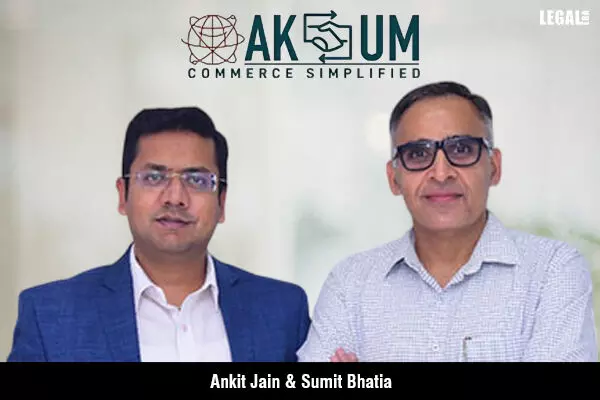
Aksum Co-Founders Sumit Bhatia & Ankit Jain Outline Adaptation Strategies On Changing Dynamics In Scaas
The duo state that resilience now means strategic alignment and foresight and one must adapt accordingly
Aksum Trademart, co-founded in 2021, by Sumit Bhatia and Ankit Jain is headquartered in New Delhi. It is India’s first business-to-business (B2B) Supply Chain-as-a-Service (SCaaS) platform with focus on solving the supply chain issues faced by Small and Medium-Sized Enterprises (SME’s) and the corporates.
As India's supply chain ecosystem is experiencing a transformative shift, amid global trade disruptions, shifting regulations and rapid digitization, SCaaS has gained momentum. Businesses are turning to technology, policy reforms, and strategic resilience to navigate growing complexities.
Sumit Bhatia and Ankit Jain speak about the company’s adaptation strategies to these dynamic changes:
On ongoing deregulation efforts in India on the logistics and warehousing sectors
The introduction of the Goods and Services Tax (GST) has been a pivotal reform. It simplified inter-state movement, dismantled previous tax-related hurdles, and enabled a more integrated national logistics framework. Moreover, with the deployment of advanced logistics software and real-time triangulation systems, companies can now track vehicle movements from origin to delivery with remarkable precision. These technologies enhance transparency, traceability, and compliance, ultimately unlocking key supply chain efficiencies for businesses across sectors.
On international conflicts disrupting global trade routes
India is strategically positioned to provide resilience in global supply chains, particularly for markets in the Middle East, Southeast Asia, and parts of Europe. Despite disruptions in specific regions such as Eastern Europe, India's major trade corridors remain largely unaffected. Indian exporters, especially in sectors like custom steel fabrication and engineered components, continue to offer cost competitiveness and reliability. The growing emphasis on bilateral trade agreements, coupled with a robust domestic manufacturing base, makes India an increasingly attractive partner in turbulent times.
On SCaaS companies fortifying themselves
SCaaS companies have a distinct advantage in today's landscape by tapping into the strength of India's domestic market, which continues to see robust demand due to ongoing infrastructure development and industrial expansion. Focusing on local opportunities through the lens of ‘Make in India’ ensures a strong foundation. Internationally, the key lies in diversifying trade routes, building agile supplier ecosystems, and leveraging data-driven technologies to anticipate and mitigate risks. Geopolitical realities are also shifting, with trade becoming a diplomatic tool. Thus, resilience now also means strategic alignment and foresight.
On key verticals driving demand for SCaaS in India
The infrastructure sector is a primary growth engine, supported by large-scale public and private investments. Additionally, industries such as manufacturing, construction, metals, and engineering are driving demand for integrated, tech-enabled supply chain solutions. The increasing digitization of supply chains, transparency through regulatory platforms, and the emergence of exchange-based procurement models are further fueling the need for agile and scalable SCaaS offerings across these verticals.
On Artificial Intelligence (AI), Internet of Things (IoT), and blockchain
We are at the cusp of a major transformation. Technologies like blockchain, though still emerging, have the potential to redefine how contracts are structured-particularly in sectors where provenance and traceability are critical, such as scrap and recycled materials. AI and IoT, on the other hand, are enabling smarter SLAs based on predictive analytics and real-time performance tracking. As adoption grows, we expect legal frameworks and risk-sharing models to evolve, becoming more data-driven, automated, and outcome-based, offering far greater accountability across the supply chain ecosystem.



