


Javed Akhtar Emphasizes Importance Of IP Laws At FICCI Event
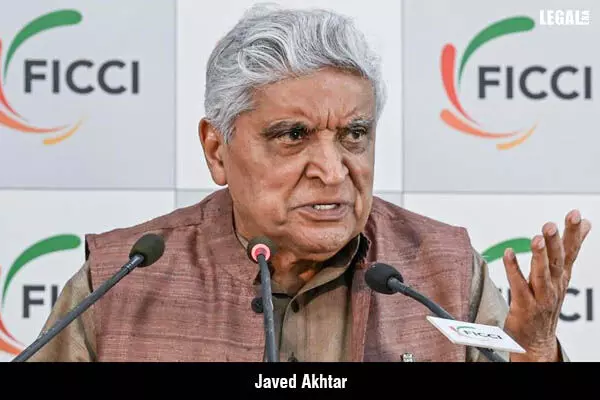
Javed Akhtar Emphasizes Importance Of IP Laws At FICCI Event
Supports implementation of the Copyright Act for the music industry
While speaking at the Federation of Indian Chambers of Commerce and Industry’s (FICCI’s) event, ‘IP and Music: Feel the beat of IP’ in New Delhi, veteran screenwriter and poet Javed Akhtar highlighted the need for financial security for artists through strong Intellectual Property (IP) laws.
He emphasized that secure artists created better music and advocated for the implementation of the Copyright Act, 2021.
At the function, Vivek Agarwal, Secretary, Union Ministry of Culture, announced partnerships with Spotify and YouTube to promote folk music, alongside Geographical Indication registration for traditional instruments and styles.
Agarwal announced several initiatives to bolster India's creative economy, including partnerships with digital streaming platforms.
He expressed, "We are in discussions with Spotify and YouTube to sign a Memorandum of Understanding (MoUs) to promote folk and traditional music that currently lacks commercial market presence.”
The Secretary added, "Every region of this country has a unique musical setup that deserves protection.”
Meanwhile, Akhtar reiterated that an artist should have the freedom to refuse the work he does not want to do. But that could happen only if the person was financially secure.
The chairperson of the Indian Performing Right Society (IPRS), Akhtar said that if the artist was secure, it would reflect on the overall state of the Indian music industry.
The lyricist, credited for songs such as Dekha Ek Khwaab, Ek Ladki Ko Dekha Toh Aisa Laga, Ghar Se Nikalte Hi, and Dard-e-Disco, said the shelf life of music was "reducing by the day" all over the world.
Akhtar stated, “The music is not heartfelt, it is ordered. They have been told to do this. They don't have freedom. Wherever they have freedom, they will make the music industry more alive and potent. This can only happen through any kind of good creative work. It can happen if you give power to the artists. Whatever he (artists) has done, he should be rewarded for that. Economically, financially, he should be secure. He should be able to say no.”
He added, "As long as he is straitjacketed in such conditions where he has to survive financially to get two square meals on the table for his family, how can he? There are martyrs who do that, but we can't expect everybody to do that. We need the security of the artist for the security of the music industry. We need strong rules that are implemented on the ground for a healthier music industry.”
Expressing that there must be a balance between creativity and marketing, he said, "You have to make your market, that's called marketing. If you are adhering to the market, then what kind of marketing person are you? There is no creativity in you. No experiment, no courage. How do you make an artist say, 'No, I will not do this. I have the right'? That is where the IP laws come in."
The cinema veteran said that when the work was innovative, heartfelt, and had variety, it would do better business. "Whatever you do from the depth of your heart, it reaches other people's hearts. Your dishonesty, cold-blooded attitude towards the work also gets conveyed instinctively," he went on.
Meanwhile, the IPRS website legitimizes the use of copyrighted music by issuing licenses to 'users' and collects royalties for, and on behalf of, its members. The body helps authors, composers, and music publishers in getting a fair share of royalties, while assisting the users to legally play music.
In 2017, when Akhtar took over IPRS, the annual income was at its peak all over the world and in India, it was Rs.42 crore. In the last eight years, it has crossed Rs.730 crore. "It is still a work in progress. In a couple of years, hopefully, we'll cross Rs.1,000 crore," he pointed.
Akhtar praised Commerce and Industry Minister Piyush Goyal for "going out of his way" to see that the Copyright Act was implemented. However, he said, the IPRS intended to inform the government that IP laws were "not being implemented on the ground. If these are implemented, I see a very bright future for the Indian music industry.”
FICCI IPR Committee Chairman Anil Rajput announced signing an MoU with the World Intellectual Property Organization (WIPO) to establish an IP for Business Center at FICCI after a decade-long effort.
Rajput said, "The centre will serve as a pivotal resource for Indian businesses, creators and innovators.”
Calling for "protection from negative impacts while building an ecosystem that leverages AI as a positive enabler," he addressed the dual impact of artificial intelligence (AI) on the music industry.



